
Neon Divide
Signal Lost
8.9/10Race across a fractured megacity where pirate broadcasts redraw the streets, rival stations fight for every listener, and the fastest route may not exist until somebody puts it on the air.
The first thing Neon Divide asks you to do is tune the radio. A storm has knocked half of Vesper City off the official network, the navigation display is a mess of dead zones, and a pirate host calling herself Relay is trying to guide stranded drivers home. Twist the dial through the static, catch her signal, and an unmarked service road flickers into existence beneath the elevated train. Miss the frequency and the race continues without it.
That moment explains Signal Lost better than any burst of exhaust flame. Neon Divide is a high-speed driving adventure set in a megacity whose roads, stories, and loyalties change with the broadcasts reaching each district. Racing remains the immediate thrill, but the radio is what gives every run a purpose. Stations report opportunities, argue over which routes are safe, spread rumours about rival crews, and sometimes lie. Choosing who to hear can matter as much as choosing where to turn.
Vesper was designed as one connected city before an event known as the Blackout split its network into isolated zones. Corporate towers still glow above the clouds, but the streets below have become a patchwork of community transmitters and improvised power grids. The old central traffic system continues to issue instructions despite having no reliable picture of the roads. Local broadcasters fill that gap, each with a different idea of what the city should become when the lights return.
The player begins as an anonymous courier with a battered receiver and a car assembled from three incompatible models. Early jobs are practical: carry medicine across a flooded underpass, deliver replacement valves to a rooftop farm, or escort a mobile transmitter through hostile territory. Completing them increases a station’s reach. Its music becomes clearer, its presenters gain confidence, and new road signs appear in districts where its listeners have taken control.
Broadcast coverage also changes the races themselves. A community station might unlock garage doors to create shortcuts through apartment blocks. A commercial network clears traffic but fills the route with aggressive security drones. The city’s nostalgic oldies channel persuades veteran drivers to reveal forgotten tunnels, while an anonymous numbers station marks impossible-looking jumps with bursts of coded light. No frequency is simply good or evil. Every clearer signal pushes another voice further into the noise.
Driving sits on the generous side of arcade handling. Cars carry weight into a corner, but a confident drift can be held with a clean sweep of the stick rather than a degree in suspension geometry. Drafting charges a short-range signal pulse used to disrupt electronic barriers, expose hidden lane markings, or briefly scramble a rival’s navigation. The pulse does not behave like a weapon; it is a way of reading and manipulating the road while moving too quickly to stop.
The best routes layer those ideas together. In the Glass Market, rain turns solar awnings into reflective ramps while a station engineer talks the player through a sequence of colour-coded shutters. The Split, a canyon between severed tower blocks, has three levels of traffic moving in opposite directions and a rail line that becomes a road only during scheduled maintenance windows. Out by the seawall, lightning temporarily powers sections of an abandoned magnetic highway. A perfect run is part racing line, part radio play, and part memory.
Rivals are more than names above cars. Each crew follows a station, has favourite districts, and reacts to the player’s choices. Help a broadcaster expose a rigged tournament and its champion may become an ally. Knock a neighbourhood relay offline for quick payment and local racers will remember the silence. Story encounters happen at full speed through calls, interruptions, and music rather than dragging the player out of the car for another briefing in a warehouse.
Vesper avoids the dead acreage that can make open-world racers feel like enormous menus. Districts are dense, vertically layered, and visibly shaped by earlier runs. Billboards swap owners. Rooftop antennas multiply. A once-dark housing block lights up floor by floor after its substation is restored. Fast travel exists, but the radio continues to surface small jobs and conversations on familiar roads, making an ordinary drive across town feel useful without covering the map in icons.
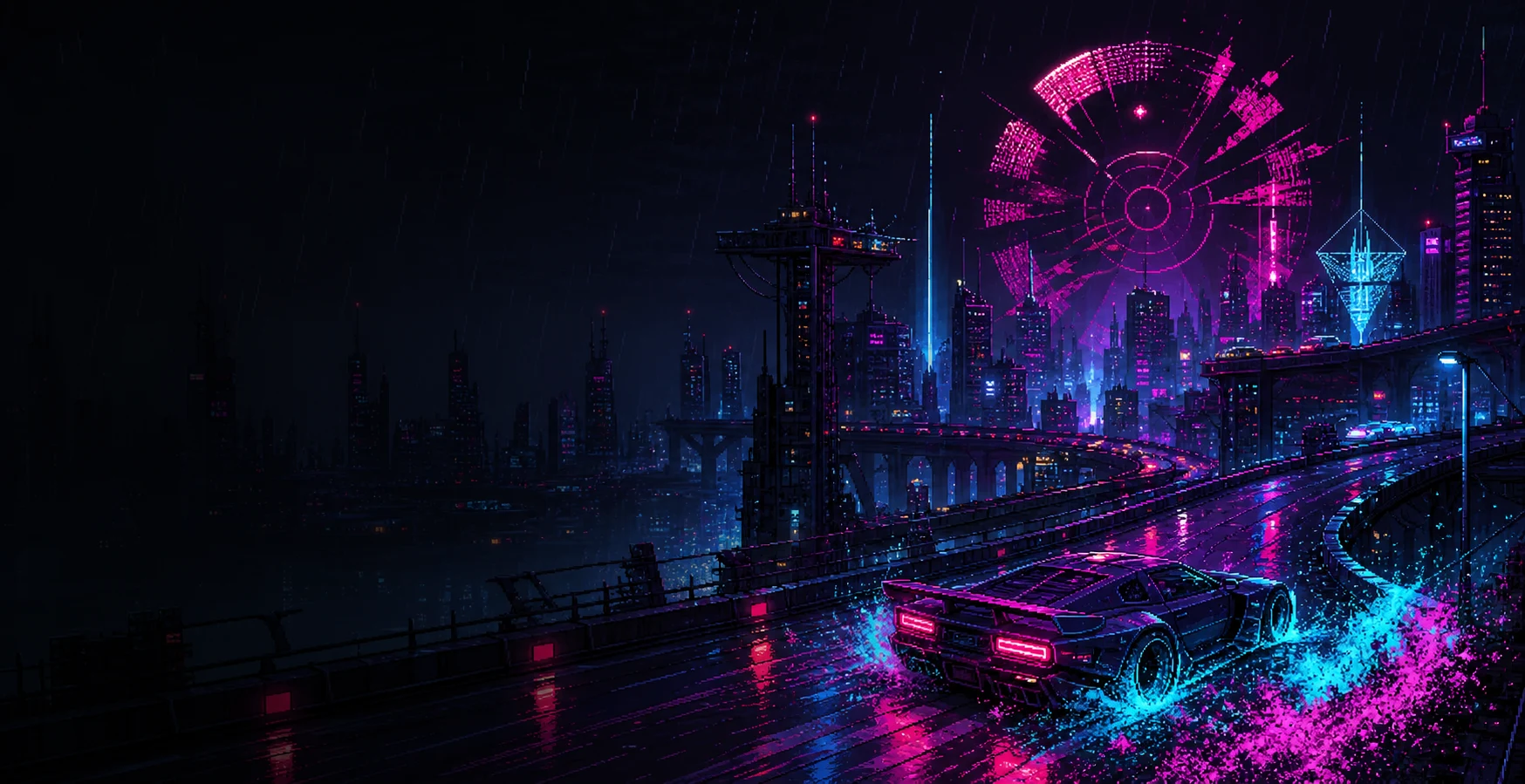
The presentation is gloriously committed. Wet asphalt catches cyan brake lights, trains throw bands of white across the street, and distant towers dissolve into magenta rain. Crucially, the spectacle does not bury the route. Barriers, hazards, and interactive signal objects have strong shapes that remain readable at speed. The wide city vistas look extravagant on a large display, while the darker cockpit and bumper views keep the road clear during Vesper’s busiest night races.
Music shifts with signal strength rather than changing at hard district boundaries. A bass line may arrive first through static, followed by drums as the car climbs toward an antenna, then the full track bursts in when a rooftop jump clears the interference. Presenters talk across songs without constantly repeating instructions, and rival broadcasts sometimes bleed together at the border between territories. The result sounds like a real contested airwave instead of a playlist with mission dialogue pasted over it.
Signal Lost still has questions to answer. Its reactive city will need enough variation to support long-term exploration, and a story delivered almost entirely from the driver’s seat risks becoming noise during difficult races. What we have seen, however, understands that radio is uniquely suited to a driving game. It can guide without stopping, reveal character without a cutscene, and make an empty road feel connected to people beyond the windshield.
Neon Divide has the speed and neon swagger required to earn attention. More importantly, it has an idea that ties those pleasures to the world. Every race extends a signal. Every station changes the map. Every shortcut says something about who controls the street beneath it. Vesper City may have lost its network, but we are already searching the dial for another transmission.
That moment explains Signal Lost better than any burst of exhaust flame. Neon Divide is a high-speed driving adventure set in a megacity whose roads, stories, and loyalties change with the broadcasts reaching each district. Racing remains the immediate thrill, but the radio is what gives every run a purpose. Stations report opportunities, argue over which routes are safe, spread rumours about rival crews, and sometimes lie. Choosing who to hear can matter as much as choosing where to turn.
Vesper was designed as one connected city before an event known as the Blackout split its network into isolated zones. Corporate towers still glow above the clouds, but the streets below have become a patchwork of community transmitters and improvised power grids. The old central traffic system continues to issue instructions despite having no reliable picture of the roads. Local broadcasters fill that gap, each with a different idea of what the city should become when the lights return.
The player begins as an anonymous courier with a battered receiver and a car assembled from three incompatible models. Early jobs are practical: carry medicine across a flooded underpass, deliver replacement valves to a rooftop farm, or escort a mobile transmitter through hostile territory. Completing them increases a station’s reach. Its music becomes clearer, its presenters gain confidence, and new road signs appear in districts where its listeners have taken control.
Broadcast coverage also changes the races themselves. A community station might unlock garage doors to create shortcuts through apartment blocks. A commercial network clears traffic but fills the route with aggressive security drones. The city’s nostalgic oldies channel persuades veteran drivers to reveal forgotten tunnels, while an anonymous numbers station marks impossible-looking jumps with bursts of coded light. No frequency is simply good or evil. Every clearer signal pushes another voice further into the noise.
Driving sits on the generous side of arcade handling. Cars carry weight into a corner, but a confident drift can be held with a clean sweep of the stick rather than a degree in suspension geometry. Drafting charges a short-range signal pulse used to disrupt electronic barriers, expose hidden lane markings, or briefly scramble a rival’s navigation. The pulse does not behave like a weapon; it is a way of reading and manipulating the road while moving too quickly to stop.
The best routes layer those ideas together. In the Glass Market, rain turns solar awnings into reflective ramps while a station engineer talks the player through a sequence of colour-coded shutters. The Split, a canyon between severed tower blocks, has three levels of traffic moving in opposite directions and a rail line that becomes a road only during scheduled maintenance windows. Out by the seawall, lightning temporarily powers sections of an abandoned magnetic highway. A perfect run is part racing line, part radio play, and part memory.
Rivals are more than names above cars. Each crew follows a station, has favourite districts, and reacts to the player’s choices. Help a broadcaster expose a rigged tournament and its champion may become an ally. Knock a neighbourhood relay offline for quick payment and local racers will remember the silence. Story encounters happen at full speed through calls, interruptions, and music rather than dragging the player out of the car for another briefing in a warehouse.
Vesper avoids the dead acreage that can make open-world racers feel like enormous menus. Districts are dense, vertically layered, and visibly shaped by earlier runs. Billboards swap owners. Rooftop antennas multiply. A once-dark housing block lights up floor by floor after its substation is restored. Fast travel exists, but the radio continues to surface small jobs and conversations on familiar roads, making an ordinary drive across town feel useful without covering the map in icons.
The presentation is gloriously committed. Wet asphalt catches cyan brake lights, trains throw bands of white across the street, and distant towers dissolve into magenta rain. Crucially, the spectacle does not bury the route. Barriers, hazards, and interactive signal objects have strong shapes that remain readable at speed. The wide city vistas look extravagant on a large display, while the darker cockpit and bumper views keep the road clear during Vesper’s busiest night races.
Music shifts with signal strength rather than changing at hard district boundaries. A bass line may arrive first through static, followed by drums as the car climbs toward an antenna, then the full track bursts in when a rooftop jump clears the interference. Presenters talk across songs without constantly repeating instructions, and rival broadcasts sometimes bleed together at the border between territories. The result sounds like a real contested airwave instead of a playlist with mission dialogue pasted over it.
Signal Lost still has questions to answer. Its reactive city will need enough variation to support long-term exploration, and a story delivered almost entirely from the driver’s seat risks becoming noise during difficult races. What we have seen, however, understands that radio is uniquely suited to a driving game. It can guide without stopping, reveal character without a cutscene, and make an empty road feel connected to people beyond the windshield.
Neon Divide has the speed and neon swagger required to earn attention. More importantly, it has an idea that ties those pleasures to the world. Every race extends a signal. Every station changes the map. Every shortcut says something about who controls the street beneath it. Vesper City may have lost its network, but we are already searching the dial for another transmission.