
Mosslight
Echoes Below
9.1/10A tiny lantern bearer descends beneath an ancient forest, where every flame reveals a path and every echo remembers the kingdom that vanished below.
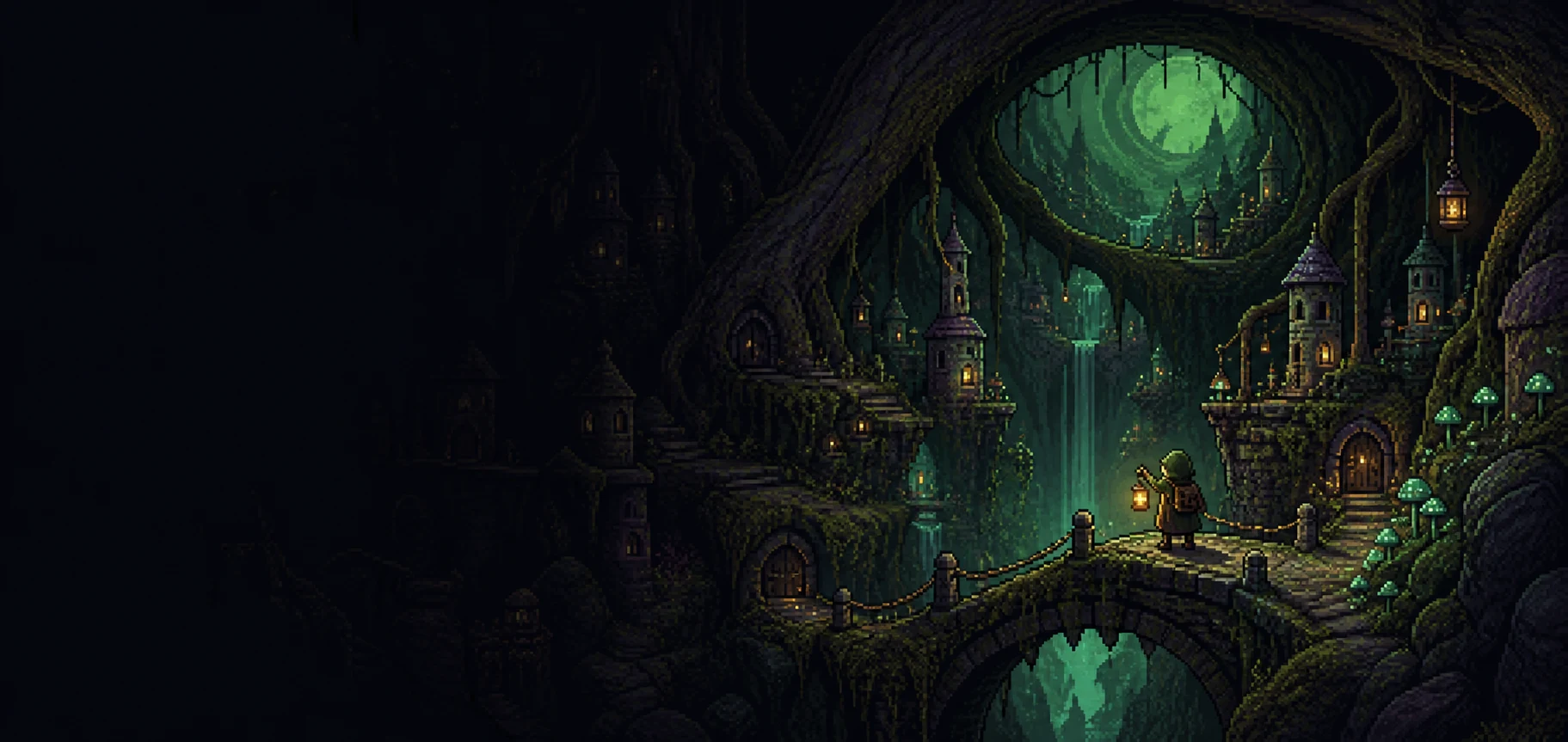
At first, Mosslight seems impossibly small. Its hero is barely taller than the lantern strapped across their back, and the first chamber beneath the forest is so broad that its ceiling disappears into blue-green darkness. Then the flame catches a row of carvings in the stone. One flickers. Another answers. A bridge of roots slowly wakes across the gulf, and the forgotten kingdom below begins to feel less empty than asleep.
That contrast is the heart of Echoes Below. Mosslight is an exploration adventure about carrying one fragile source of warmth through a place built on an enormous scale. There are drowned libraries, bell towers tangled in roots, abandoned kitchens occupied by pale beetles, and entire streets preserved beneath curtains of moss. The world is melancholy without becoming miserable. Tiny signs of ordinary life—a cup beside a cold stove, chalk games on a wall, a repaired wooden toy—give its ruins a tenderness that grander fantasy games often miss.
The lantern is more than a torch. Its light can be focused into a narrow beam to reveal ink hidden on walls, spread into a soft glow that encourages plants to unfurl, or briefly shuttered when creatures hunt by brightness. New oils alter the flame rather than simply making it stronger. Amber light holds ancient machinery in motion. Silver light exposes the trails left by spirits. A smoky violet flame slips through crystal and projects shapes onto distant surfaces. Puzzles begin with the familiar pleasure of spotting the right colour, then become clever exercises in carrying light through mirrors, water, moving roots, and rooms that rearrange when darkness falls.
Mosslight’s other defining idea is the echo. Certain objects retain a memory of sound: a gate recalls the rhythm once used to open it, while an empty theatre holds fragments of its final performance. The lantern bearer can collect those fragments and replay them elsewhere. A remembered lullaby may calm a territorial animal several chambers later. The measured strike of a forge can become the missing beat in a clockwork lock. These echoes make the kingdom feel connected, rewarding players who remember details instead of treating every puzzle as an isolated box.
There is danger below the roots, but this is not a game about clearing rooms. Mosslight can distract larger creatures with thrown sparks, hide inside seed pods, and use bursts of flame to break a pursuit. The most memorable encounters behave like moving environmental puzzles. One blind guardian follows vibrations through a flooded archive, forcing careful steps across floating books. Another circles a dark orchard and changes its route whenever the player lights a new branch. Escaping feels satisfying because observation matters more than reflexes, and because the creatures belong to the ecosystem rather than waiting around as targets.
The underground kingdom opens gradually around a central settlement called the Wickrest. Rescued wanderers return there with practical skills: a cartographer marks suspicious gaps on the map, a moth tailor turns shed wings into gliding cloth, and a taciturn cook prepares meals that change how long different lantern oils burn. Their stalls physically fill the once-empty station. Music gains new instruments as the population grows. Even the route back changes, with repaired lifts and root tunnels folding distant regions into a compact network.
That structure gives exploration a lovely rhythm. A descent into an unknown district is tense and lonely; the journey home is quick, familiar, and full of small discoveries made possible by whatever was found below. The map records landmarks but does not smother rooms in icons. Instead, players can place a limited number of hand-drawn symbols. Marking a sealed bell or an unreachable ledge feels personal, and returning hours later with the right flame creates the sort of satisfying mental click that no checklist can reproduce.
The visual craft holds all of this together. Characters have expressive, economical animation, while backgrounds layer damp stone, translucent leaves, drifting spores, and distant architecture without losing readability. Darkness is allowed to be genuinely dark, but important edges catch just enough colour to guide the eye. On a larger screen the lighting reveals beautiful reflections and soft clouds of pollen. On Switch, the strong silhouettes and warm lantern glow remain wonderfully legible in handheld play.
Sound may be Mosslight’s quiet triumph. Footsteps change from soil to shell, stone, wood, and shallow water. Pipes carry noises from rooms not yet reached. The score often recedes until only the lantern’s glass rattle and a low subterranean hum remain, then folds a recovered echo into the music when a puzzle is solved. Headphones are not required, but they make the kingdom feel convincingly wrapped around the player.
There are still mysteries surrounding the journey. The lantern bearer’s reason for descending is presented in fragments, and the origin of the roots pressing through the city remains deliberately uncertain. What matters now is that Mosslight understands the pleasure of going somewhere forbidden with just enough light to take one more step. Its puzzles grow naturally from the world, its small cast makes restoration visible, and its ruins tell intimate stories without stopping for a lecture.
Plenty of games promise a forgotten kingdom. Mosslight makes us want to remember one. Echoes Below turns light, sound, and curiosity into parts of the same language, then trusts the player to listen. If the full descent maintains this mixture of quiet tension and generous discovery, the little lantern at its centre could cast a very long shadow.
That contrast is the heart of Echoes Below. Mosslight is an exploration adventure about carrying one fragile source of warmth through a place built on an enormous scale. There are drowned libraries, bell towers tangled in roots, abandoned kitchens occupied by pale beetles, and entire streets preserved beneath curtains of moss. The world is melancholy without becoming miserable. Tiny signs of ordinary life—a cup beside a cold stove, chalk games on a wall, a repaired wooden toy—give its ruins a tenderness that grander fantasy games often miss.
The lantern is more than a torch. Its light can be focused into a narrow beam to reveal ink hidden on walls, spread into a soft glow that encourages plants to unfurl, or briefly shuttered when creatures hunt by brightness. New oils alter the flame rather than simply making it stronger. Amber light holds ancient machinery in motion. Silver light exposes the trails left by spirits. A smoky violet flame slips through crystal and projects shapes onto distant surfaces. Puzzles begin with the familiar pleasure of spotting the right colour, then become clever exercises in carrying light through mirrors, water, moving roots, and rooms that rearrange when darkness falls.
Mosslight’s other defining idea is the echo. Certain objects retain a memory of sound: a gate recalls the rhythm once used to open it, while an empty theatre holds fragments of its final performance. The lantern bearer can collect those fragments and replay them elsewhere. A remembered lullaby may calm a territorial animal several chambers later. The measured strike of a forge can become the missing beat in a clockwork lock. These echoes make the kingdom feel connected, rewarding players who remember details instead of treating every puzzle as an isolated box.
There is danger below the roots, but this is not a game about clearing rooms. Mosslight can distract larger creatures with thrown sparks, hide inside seed pods, and use bursts of flame to break a pursuit. The most memorable encounters behave like moving environmental puzzles. One blind guardian follows vibrations through a flooded archive, forcing careful steps across floating books. Another circles a dark orchard and changes its route whenever the player lights a new branch. Escaping feels satisfying because observation matters more than reflexes, and because the creatures belong to the ecosystem rather than waiting around as targets.
The underground kingdom opens gradually around a central settlement called the Wickrest. Rescued wanderers return there with practical skills: a cartographer marks suspicious gaps on the map, a moth tailor turns shed wings into gliding cloth, and a taciturn cook prepares meals that change how long different lantern oils burn. Their stalls physically fill the once-empty station. Music gains new instruments as the population grows. Even the route back changes, with repaired lifts and root tunnels folding distant regions into a compact network.
That structure gives exploration a lovely rhythm. A descent into an unknown district is tense and lonely; the journey home is quick, familiar, and full of small discoveries made possible by whatever was found below. The map records landmarks but does not smother rooms in icons. Instead, players can place a limited number of hand-drawn symbols. Marking a sealed bell or an unreachable ledge feels personal, and returning hours later with the right flame creates the sort of satisfying mental click that no checklist can reproduce.
The visual craft holds all of this together. Characters have expressive, economical animation, while backgrounds layer damp stone, translucent leaves, drifting spores, and distant architecture without losing readability. Darkness is allowed to be genuinely dark, but important edges catch just enough colour to guide the eye. On a larger screen the lighting reveals beautiful reflections and soft clouds of pollen. On Switch, the strong silhouettes and warm lantern glow remain wonderfully legible in handheld play.
Sound may be Mosslight’s quiet triumph. Footsteps change from soil to shell, stone, wood, and shallow water. Pipes carry noises from rooms not yet reached. The score often recedes until only the lantern’s glass rattle and a low subterranean hum remain, then folds a recovered echo into the music when a puzzle is solved. Headphones are not required, but they make the kingdom feel convincingly wrapped around the player.
There are still mysteries surrounding the journey. The lantern bearer’s reason for descending is presented in fragments, and the origin of the roots pressing through the city remains deliberately uncertain. What matters now is that Mosslight understands the pleasure of going somewhere forbidden with just enough light to take one more step. Its puzzles grow naturally from the world, its small cast makes restoration visible, and its ruins tell intimate stories without stopping for a lecture.
Plenty of games promise a forgotten kingdom. Mosslight makes us want to remember one. Echoes Below turns light, sound, and curiosity into parts of the same language, then trusts the player to listen. If the full descent maintains this mixture of quiet tension and generous discovery, the little lantern at its centre could cast a very long shadow.